NIH Director's New Innovator Award

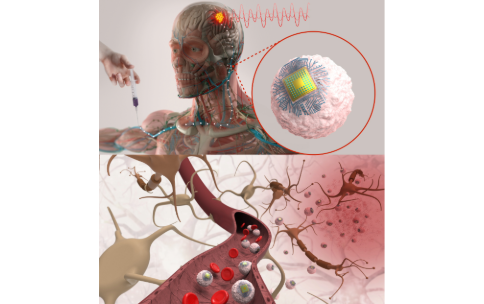
The ability to safely activate specific regions of the brain has transformed the treatment of many neurological disorders—conditions that affect the brain and nervous system. However, achieving this targeted activation requires devices that must be placed through invasive surgery, which carries risks including infection, tissue damage, and long recovery times. High-Risk, High-Reward Research (HRHR) New Innovator Award recipient Deblina Sarkar, Ph.D., and her team at the Massachusetts Institute of Technology (MIT) are making significant strides toward providing a lower-risk, noninvasive alternative through a new platform called Circulatronics.
Circulatronics is a noninvasive system that uses small electronic devices, designed to replace implants that currently require surgery to treat brain disorders. These tiny wireless implants, each smaller than a single cell, are designed to attach to immune cells outside the body for delivery back into the bloodstream through a single injection. Acting as natural delivery vehicles, the immune cells would carry the implants through the bloodstream to areas of the brain where inflammation is present. From there, the devices would self-implant and could then be wirelessly powered using near-infrared light to activate nerve cells in a targeted area.
The technology was tested in mice and showed precise, nonsurgical implantation in inflamed regions of the brain. Additionally, the implants in mice did not produce detectable adverse effects on behavior, blood chemistry, or organ health. While still in the early stages of research, future versions of this technology could be designed to remain in the body long term or safely break down in the body after treatment. Circulatronics shows promise as a future platform for treating a range of neurological disorders with potential applications in Alzheimer's disease, multiple sclerosis, stroke, brain tumors, nerve pain, and nerve injuries. If determined to be safe and effective in humans, Dr. Sarkar’s research could lead to a new generation of self-implanting bioelectronic devices capable of wireless brain activation, sensing, recording, and therapy without the need for invasive procedures.
Reference:
Yadav, S., Lee, R.X., Kajale, S.N. et al. A nonsurgical brain implant enabled through a cell–electronics hybrid for focal neuromodulation. Nat Biotechnol (2025). https://doi.org/10.1038/s41587-025-02809-3