Rigor, Replicability, & Reproducibility to Promote Excellence, Accuracy, and Translation in Science (R3PEATS)
Rigor, Replicability, & Reproducibility to Promote Excellence, Accuracy, and Translation in Science (R3PEATS)

Program Snapshot
The NIH Common Fund’s Rigor, Replicability, & Reproducibility to Promote Excellence, Accuracy, and Translation in Science (R3PEATS) Program will address the critical need for increased rigor, replicability, and reproducibility (R3) in biomedical research and drive a change in culture to prioritize these efforts.
Advancing R3 in biomedical research helps ensure that promising findings are reliable, and that patients ultimately benefit from treatments built on solid evidence. Yet the scientific enterprise still faces significant gaps in achieving this: researchers often lack clear ways to interpret and learn from findings that don't replicate, team science is not often measured or encouraged in ways that reflect its value, and the "publish or perish" mindset pressures continue to favor topic novelty and volume of manuscript production. These gaps can lead to misinterpreted results, misaligned incentives, and research that doesn't hold up, ultimately slowing progress for scientists and the patients who stand to benefit from their work.
R3PEATS aims to fill these gaps by creating unprecedented opportunities for collaboration and systematic investigation into the factors that shape experimental replicability. Taking a metascience (science of science) approach, the program will foster lasting culture change by integrating R3 into the scientific ecosystem, research practices, and biomedical workforce that drive the biomedical enterprise.
R3PEATS is guided by 3 overarching goals:
- Developing and testing cross-sector interventions to incentivize R3
- Supporting research that integrates R3 to advance biomedical discovery and identify novel contributors to biological and methodological variability
- Cultivating a network of scholars who implement and disseminate R3 practices locally and nationally
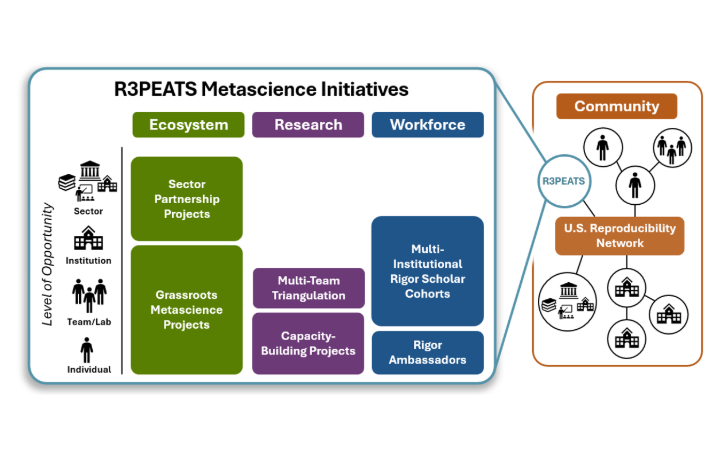
These goals will be accomplished through the following four initiatives that are intentionally designed to span the entire research enterprise:
- Ecosystem: Projects will assess and improve the support systems and culture around scientists and laboratories to better incentivize R3 practices.
- Research: Projects will directly support biomedical and behavioral research that answers investigator-initiated, NIH-relevant questions while promoting and testing factors that influence R3. These projects will enhance our understanding of biological and methodological variability and provide new models for funding and conducting research in this area.
- Workforce: Projects will support and develop people by helping researchers build the skills, systems, and leadership needed to promote R3 in the laboratory and the broader scientific community.
- Community: Initial infrastructure support will help establish a sustainable, self-organized peer network of academic institutions, researchers, and other stakeholders committed to improving R3.
The R3PEATS program funding opportunities are expected to be announced in 2027. The forecast notices are now available on Grants.gov. These forecasts are intended to help the research community prepare for future funding opportunities and begin planning potential applications.
Sign up for the R3PEATS listserv to hear about future announcements.
Have a question? Reach out to us at: [email protected]
To learn about additional Common Fund efforts to understand scientific replicability, visit: the Replication to Enhance Research Impact Initiative website.
To learn more about replicability efforts across NIH, visit: Strengthening Replication and Reproducibility of NIH-funded Research
Program Updates
On September 10, 2026, The NIH Council of Councils approved the concept of the NIH Common Fund's R3PEATS Program. To learn more, visit the Council of Councils presentation slides and the R3PEATS Program summary.
View forecasts for funding opportunities expected to be published in 2027.
Sign up for the R3PEATS listserv to hear about future announcements.
Have a question? Reach out to us: [email protected].