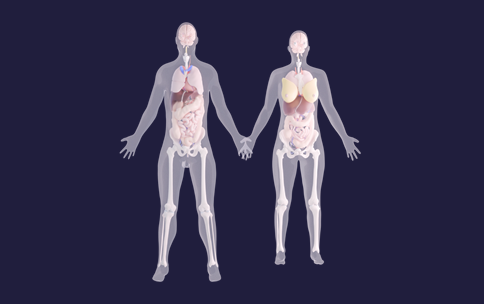
Scientists often face challenges connecting findings about human cells because data are spread across hundreds or even thousands of separate studies and data sources. To address this challenge, NIH Common Fund-supported researchers from the Common Fund Data Ecosystem (CFDE), the Human BioMolecular Atlas Program (HuBMAP), and the Cellular Senescence Network (SenNet), created a new resource called Human Reference Atlas cell type populations (HRApop). HRApop provides a three-dimensional (3D) map of human tissues, showing both the number and location of different cell types across 73 anatomical structures in 17 organs. It is part of the Human Reference Atlas (HRA) which brings together large amounts of data, including data from the NIH Common Fund’s Genotype-Tissue Expression (GTEx) program, to map where different types of cells are located throughout the body.
Researchers combined data from hundreds of studies from 662 datasets, corresponding to more than 27 million cells. They used computational tools to consistently label cell types and map the location of those cells in the body. The result is a detailed map of healthy human tissues at the cellular level that researchers can use as a reference for future studies.
This high-quality, curated dataset helps researchers see how cells are arranged in the body, making it easier to spot differences between healthy and diseased tissues and to better understand how diseases begin and develop. HRApop can also help researchers find new ways to detect and treat diseases by showing where specific cell types are located in a healthy, adult human body. In addition, these 3D maps can support interactive tools, including virtual reality (VR) applications, that allow researchers and educators to explore human tissues in more intuitive and interactive ways.
While HRApop provides a powerful map of healthy human cells, it does not capture all cell types or fully reflect how cells change in disease, over time, or across different populations, which will be the focus of future HRApop versions. Even with these limits, HRApop brings complex and scattered data into a single, usable map that helps researchers study human biology across organs. This tool also demonstrates how researchers supported by multiple NIH Common Fund programs – CFDE, HuBMAP, and SenNet – collaborated to support NIH’s efforts to make complex biomedical data easier to use to stimulate new discoveries and more precise approaches to diagnosis, prevention, and treatment.
Reference:
Bueckle A, Herr BW 2nd, Chen L, Bolin D, Qaurooni D, Ginda M, Jain Y, Puig-Barbe A, Ardlie K, Wang F, Börner K. Cell Type Populations for 3D Anatomical Structures of the Human Reference Atlas. Sci Data. 2026 Mar 19. doi: 10.1038/s41597-026-06642-4. PMID: 41857048.