NIH Director's New Innovator Award
Advances in brain-computer interfaces (BCIs)—systems that allow direct communication between the brain and external devices—have long promised to restore mobility and provide greater independence for people with paralysis. However, non-invasive BCI systems often struggle with speed and accuracy. A new innovation from researchers at the University of California, Los Angeles (UCLA) may help overcome those limitations.
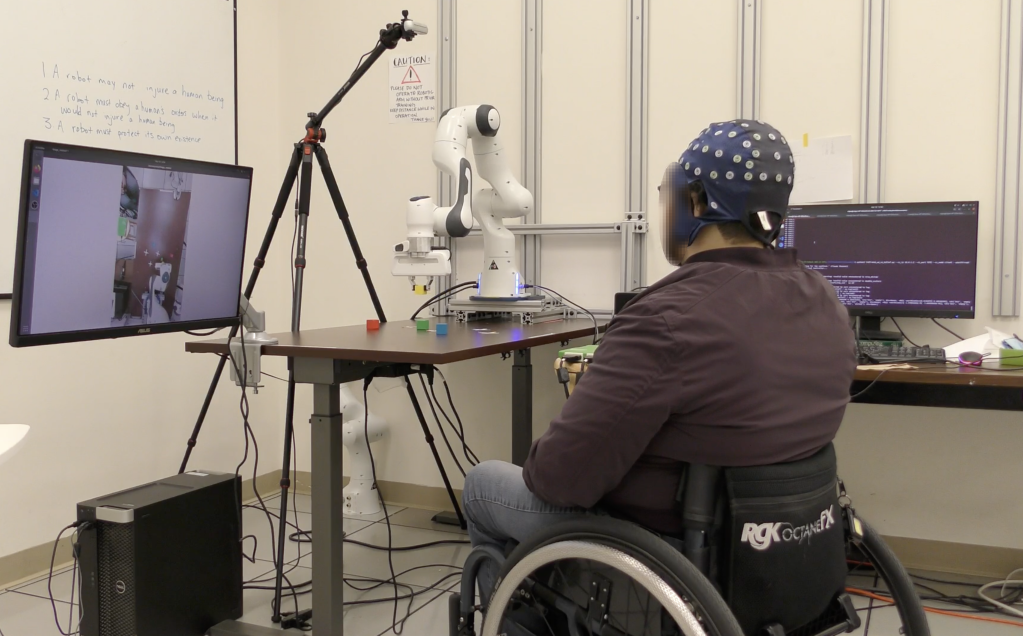
Jonathan Kao, Ph.D., a recipient of both a High-Risk, High-Reward Research (HRHR) 2020 NIH Director's New Innovator Award and a 2025 NIH Director's Pioneer Award, and his research team at UCLA developed a wearable, non-invasive BCI. The system uses electroencephalography (EEG)-based decoding, a method measuring brain activity through sensors placed on the scalp and translates those signals into digital commands. The researchers paired this method with a camera-enabled artificial intelligence (AI) “co-pilot” that uses visual cues to interpret user intent in real time.
In early tests involving four participants, three participants without motor impairments and one person with paralysis, the AI-assisted BCI allowed users to use brain signals to steer an on-screen cursor to various targets and complete a robotic arm “pick-and-place” task, doing both more quickly and accurately than without the AI technology. Notably, the participant with paralysis was only able to complete the robotic task when the AI “co-pilot” was active, demonstrating the life-changing potential of this new technology.
Unlike earlier systems relying only on brain signals, the AI “co-pilot” combines EEG data with visual context to anticipate user goals and help guide movement. This dual approach reduces errors and could support use outside the laboratory, from daily activities at home to rehabilitation in hospitals. Because the device is lightweight and non-invasive, it could be scaled more easily and made accessible to a wider population. This breakthrough points to a future where people with paralysis or severe motor impairments can improve mobility and regain greater independence.
View the video demonstration to see what this incredible technology can do:
References:
Lee, J.Y., Lee, S., Mishra, A. et al. Brain–computer interface control with artificial intelligence copilots. Nat Mach Intell 7, 1510–1523 (2025). https://doi.org/10.1038/s42256-025-01090-y