NIH Director's Early Independence Award
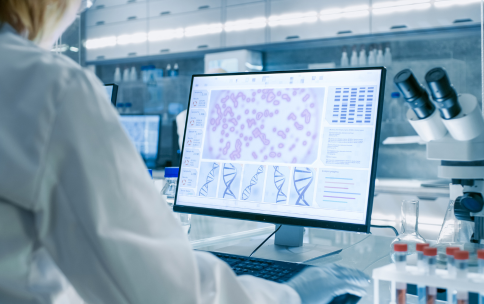
DNA is the blueprint of life, storing essential instructions within genes. Occasionally, mutations can occur in the DNA sequence of a gene, leading to genetic disorders that can be passed down, like color blindness, cystic fibrosis, or sickle cell anemia. Accurately identifying genetic mutations and DNA modifications that cause disease is challenging, and understanding how they affect the body is even more difficult.
To address this problem, NIH Director's High-Risk, High Reward Early Independence Award recipient Andrew Stergachis M.D., Ph.D. at the University of Washington School of Medicine, and his research team developed cutting-edge technology that reveals genetic disruptions that can be missed by conventional methods.
The team turned to multi-omics – an approach that looks beyond DNA sequence alone to uncover mutations that cause disease. While DNA contains basic genetic code, multi-omics combines layers of biological information – changes to DNA structure, interactions between DNA and other molecules, and other gene activity – to provide a more complete picture of how cells work. While multi-omics is not new, Dr. Stergachis’s group transformed the approach by pairing it with long-read sequencing, a technique that reads longer stretches of DNA at once. This let them gather several types of information from the same sample more accurately, reducing noise and improving resolution.
The research group applied their technology to cells from a 9-month-old patient suffering from an undiagnosed disease to determine the likely genetic cause. A genetic anomaly had already been discovered in this patient’s cells, but the team discovered that this anomaly disrupted other genes in ways researchers had not previously recognized. The patient had a large chromosome rearrangement where one chromosome had broken and fused with a different chromosome. Using their new multi-omics technology, the team identified four genes that were disrupted due to this break that traditional approaches failed to detect. Like falling dominoes, these additional genetic disruptions likely led to deficiencies in the cells, helping explain the patient’s symptoms. Their multi-omic approach was crucial for this discovery and for the identification of a new genetic disorder.
In combining multiple data types, Dr. Stergachis’s group created a tool that will help researchers and clinicians build a more complete picture of how mutations disrupt normal biology. This integrated strategy marks a major advancement in diagnosing hard-to-detect genetic conditions and guiding more personalized treatments.
Vollger, M.R., Korlach, J., Eldred, K.C., … Stergachis, A.B. Synchronized long-read genome, methylome, epigenome and transcriptome profiling resolve a Mendelian condition. Nature Genetics. 57, 469–479 (2025). https://www.nature.com/articles/s41588-024-02067-0