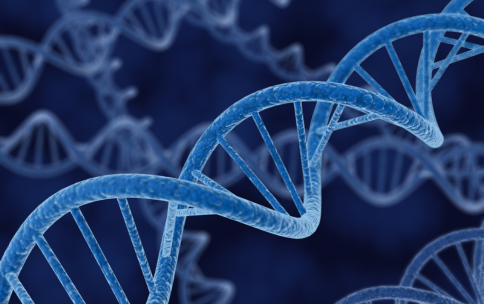
DNA contains the blueprints of life. It is not just a sequence of one message after another, but a 6-ft-long, three-dimensional molecule that is folded, looped, and compacted to fit inside the incredibly tiny nucleus of a cell. This spatial arrangement of DNA is tightly linked to how the genetic information it stores is accessed and used to control biological responses. The 4D Nucleome (4DN) program recognizes that understanding how our genomes work in health as well as disease requires knowing where things are in 3D space and how these arrangements change over time – the fourth dimension.
In a landmark collaborative effort, 4DN researchers created the most complete and comprehensive view of human DNA organization to-date. They pooled numerous cutting-edge experimental approaches to map DNA organization in two human cell types: stem cells and specialized connective tissue cells.
Their map of the human genome captures DNA architecture at every scale in unprecedented detail. They generated a catalog of over 140,000 DNA loops and created detailed 3D computer models showing how all 46 human chromosomes are arranged within the nucleus. Using advanced computational methods, they can now predict how DNA will fold based solely on its sequence – a capability that is powerful for understanding various diseases.
The team also made important discoveries about how DNA organization relates to gene activity. For example, they found that "housekeeping" genes, which are necessary in nearly every cell type, interact with many different distant regulatory sections of DNA called enhancers. Surprisingly, the same gene uses completely different enhancers in stem cells versus connective tissue cells, suggesting genes maintain activity by rewiring their 3D contacts in the DNA.
Importantly, this research provides valuable resources for further studies. The research team systematically tested each experimental method and computational approach and discovered that no single approach captures the full picture. Their work outlines the strengths of each approach and presents a practical user guide to help other researchers select the right experimental tools.
This work significantly advances our understanding of how DNA's physical structure relates to its function in different human cells across different timescales, and provides tools to predict how disease-associated genetic variants could disrupt this organization. The extensive resources they developed, including the loop catalog, spatial information, 3D models, and methodological guidelines, provide a foundation for future research into the structure and function of DNA in human health and disease.
Dekker, J., Oksuz, B.A., Zhang, Y. et al. An integrated view of the structure and function of the human 4D nucleome. Nature (2025).
Read a News and Views article about this research.
View a collection of 4DN publications in Nature family journals.