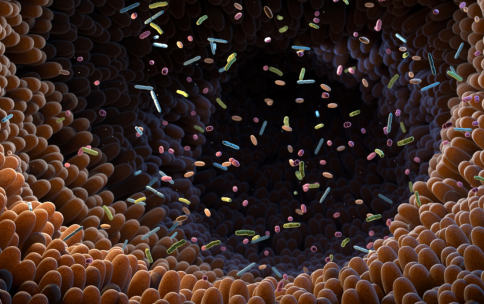
The human gut is home to thousands of microorganisms – like bacteria, fungi, and viruses – that help keep us healthy by helping food digestion, nutrient absorption, immune defense, and more. The gut also contains viruses that infect bacteria called bacteriophages, or phages. Phages play an important role in human health by helping convert food to energy and regulating the bacteria population in the gut. They are also part of the human “virome,” the vast community of viruses that reside inside the human body.
Changes to the composition and number of phages within the gut have been linked to intestinal inflammation in numerous digestive disorders like inflammatory bowel disease (IBD), but this relationship is poorly understood. Phages are notoriously difficult to work with in the lab, and it is hard to study gut bacteria in their natural environment using traditional research methods. These challenges make it hard to study how phages interact with host bacteria cells in the gut.
To address these challenges, Human Virome Program researcher Megan Baldridge, M.D., Ph.D., used a new method called viral tagging, a technique where phages are tagged with a fluorescent stain so they can be located and tracked as they interact with their bacteria host cells. This technique is capable of matching phages to their bacterial host with great specificity, without the need for growing the bacteria in the lab.
Dr. Baldridge’s research team focused on one group of gut bacteria called Faecalibacterium prausnitzii (F. prausnitzii). Though these bacteria are normally abundant in the gut, their numbers are lower in patients with IBD, suggesting that they may play an important role in maintaining a healthy gut. Only a few phages are known to infect F. prausnitzii, and little is known about how they interact. Using viral tagging, the research group studied F. prausnitzii cells from the gut and discovered over 300 new bacteria-phage matches that were missed by traditional approaches. These findings show viral tagging is a powerful tool for identifying host bacteria for phages. With these newly identified bacteria-phage pairings, scientists can begin follow-up studies to explore how each phage affects its bacterial host, how these relationships influence gut health, and whether they play a role in conditions like IBD. This study is an important first step to deciphering how phages interact with bacteria in the gut and within the wider human virome, and may lead to new insights into human health and disease.
Reference: Campbell, D. E., Wu, X., Hall, L. R., Lawrence, D., Molleston, J. M., Schriefer, L. A., … Baldridge, M. T. (2025). Single cell viral tagging of Faecalibacterium prausnitzii reveals rare bacteriophages omitted by other techniques. Gut Microbes, 17(1). https://doi.org/10.1080/19490976.2025.2526719